Weekly Update 3/2/12

Spring is not waiting for the Vernal Equinox.  Spring didn’t even wait for winter – it feels like it has been here for a while.  Daffodils are already in full bloom around town, tulips up.  If you were planning on coming to town to see the cherry blossoms, you may want to note the fact that it is looking increasingly as if they will pop early.   And one gets the sense that summer may start in late March and given the election year, it is bound to be a long, hot summer.

It certainly heated up this week around here.  And these are a few things that were interesting from my vantage point, which admittedly was limited due to another hectic week:

  • Graphic Cigarette Packs – Not So Much – A not so surprising development this week when the U.S. District Court in Washington struck down the proposed graphic packaging for the marketing of cigarettes in the U.S.  The court had already put the packs on hold last Fall and struck down the effort saying that it violated the First Amendment of the Constitution, essentially because the images weren’t designed to convey information but to evoke an emotional response.  Mum was the word from FDA in the wake of the ruling but HHS issued a rather vague statement expressing determination to “warn young people about the dangers of smoking” and confidence that efforts to stop the packaging will “ultimately fail.”
  • NIH Launches Genetic Testing Registry – Change happens.  Only a few years ago, the need for a registry to track genetic testing might have seemed very futuristic but today is reality.  This week NIH announced such a registry.  According to the release there are now genetic tests available for approximately 2500 diseases (who knew?) representing a field with a rapid growth rate.  Information included will be the “purpose of each genetic test and its limitations; the name and location of the test provider; whether it is a clinical or research test; what methods are used; and what is measured.”  You can find the registry here.
  • Statins Get a New Label Warning But I Forget Why – Just kidding – on the latter part anyway.  FDA announced this week safety changes in labeling for statins used to lower cholesterol.  The changes to the labels involve a revision to remove the need for routine periodic monitoring of liver enzymes.  That is interesting in and of itself.  In addition, the label will add information about some patients experiencing some memory loss and confusion, though the reports were termed as having “not been serious” – which raises a question.  Also included is information about increases in blood sugar levels.  More on some of this next week.

Wherever you are and whatever you are doing, I hope you have a wonderful weekend.  That’s all for me this week.  (Photo taken by friend Anne Hainsworth and used with permission)

Posted in Weekly Roundup | Comments Off

The Evolving Nature of AdComm Watching – Not for the Birds

Some people watch birds.  They get field glasses, walk in groups in wooded areas, and observe, catalog, and discuss birds.  There are volumes of books written about various aspects of bird watching.  Different shapes, different sizes, different species.  I’ve noticed, while on my dog walks, that these folks are very into what they do.

I do not bird watch.  I do watch FDA Advisory Committees.  I observe them.  I catalog them.  I discuss them.  Different shapes, different sizes and different species.  There are device ones, drug ones, biologic ones and even policy oriented ones.  I don’t have binoculars, but there is equipment one needs in pursuing this hobby.  I even compose large volumes – noting where they gather, what they do, how they interact and analyzing their behavior.  Since I began this hobby several years ago, it is notable how much things have changed.

It used to be quite more a hassle.  For example, today the curriculum vitae of each advisory committee member could only be obtained by filing a Freedom of Information Act (FOIA)  request and promise to pay for the copying.  Once filed, you could count on several weeks for the information to arrive in your mailbox.  In order to fulfill my watching hobby, I needed to file FOIA requests regularly for each and every committee and keep them in large file drawers where I would periodically have to refile when members terms expired on various committees, which of course, happens at staggered times, depending on  the committee.

Frequently, to help a client prepare, I would have to watch recordings of previous meetings involved in a particular therapeutic category, lots of them.  This involved ordering several VCR tapes and popping them into a VCR.  Today, of course, these can be placed on discs that pop into the computer.

If you couldn’t get to a meeting that was being held, you used to have to order the tapes. Today, you can watch it being web-streamed – in your car on your phone or i-Pad.

Back then, you had to wait until a reporter filed their story to find out what happened. Today, you can follow someone live blogging from the event where you can get very granular news -

“Chairperson coughed…”

“Breaking for lunch…”

“Laughter in the crowd…”

that you wouldn’t have gotten in the old days.  Or you can follow the “group think” by observing the tweets of whole flocks of people at a meeting just by watching what comes up under a hashtag on Twitter.

All this sounds like it might have been decades ago.  It wasn’t.  It was about a decade ago. A lot has changed in the past ten years.  And a lot will undoubtedly change in the decade to come.  But one thing I think will remain constant among us AdComm watchers is that, for all of our watching, I don’t think that at the end of the day, we will be any better able to tell you which way the species will fly when it comes to voting.  As recent meetings have demonstrated, we have come a long way, and we have a lot of experience, but the species is still largely elusive.

Posted in Advisory Committee Prepapartion | Comments Off

Weekly Roundup – 2/24/12

I have been super-busy, as you may have discerned from my recent lack of correspondence here.  But I am not alone!  Things have been hopping from the FDA perspective, and here are a few things that occurred this week that I thought I would pass along:

  • FDA Advisory Committee Overwhelmingly Recommends Approval of New Weight Loss Medication – To the surprise of many, the Endocrinologic and Metabolic Drugs Advisory Committee (EMDAC) at a meeting this week voted 20-2 in favor of recommending approval of Qnexa sponsored by Vivus.  There had not been a weight loss medication approved since 1999 in a category that has proven to be a tough one along many fronts.  In a previous go at approval, the sponsor received a Complete Response Letter in 2010, which was the fate of two other candidates in the category that year.  This is evidence of just how dicey predicting advisory committee outcomes can really be.
  • FDA Takes Action on Drug Shortage Issue – FDA announced this week steps that it was taking to address the on-going and well-publicized drug shortage issue as it respected two medications.  The first was Doxil, used in multiple treatment regiments, including the treatment of ovarian cancer after failure of platinum-based chemotherapy, Kaposi’s sarcoma and multiple myeloma. FDA will be allowing the temporary importation of a replacement drug called Lipodox.  In addition, FDA approved a new manufacturer of preservative-free formulation of methotrexate to help supply.  In addition to a release on the action, FDA Commissioner Margaret Hamburg wrote a blog post on the new FDA blog FDA Voice. In addition, FDA published a draft guidance on drug shortages.
  • Draft Guidance on AE Reporting – Less in the news, but interesting nonetheless, was a draft guidance issued today by FDA that is entitled “”Guidance for Industry on Postmarketing Adverse Event Reporting for Medical Products and Dietary Supplements During an Influenza Pandemic“.  Not as catch of a title as “Love in the Time of Cholera” it is nevertheless interesting precisely because it is so peculiar.  Six years ago, there as a lot of discussion and preparation around the potential for a serious flu pandemic and while it has receded from headlines for the most part, it is still poses a serious threat.  According to FDA, the guidance outlines the agency’s enforcement of AE reporting during an epidemic when there may be a high level of disruption to systems and high employee absenteeism.

That’s it for me this week.  Have a wonderful weekend everyone.  We are edging ever close to Daylight Savings Time on March 11!

Posted in Weekly Roundup | Comments Off

FDA to Examine Inhaled Caffeine

The Associated Press reported this weekend that FDA officials have expressed intent to investigate the marketing of an inhaled caffeine product.   The product, called AeroShot, is described as a fine powder that is in a lip-stick type of tube package and that delivers 100mg of caffeine along with Vitamin B that dissolves when inhaled and is being marketed as a dietary supplement. FDA wants to examine whether or not the product is fit for that category and safe for use.

It is an interesting development from a number of angles.  The website marketing of the product bills it as “breathable energy” and it is used when you open up the tube and pull in some caffeine into your mouth to dissolve there, providing you with an energy boost that the website says is equivalent to a cup of coffee without the calories and without filling you up.  You put the caffeine in your mouth where it is dissolved, but it is billed as “breathable energy”.

That differentiates it from an energy drink, or from coffee itself, which might be filling and might have calories.

It will be interesting to watch FDA approach this new category of “breathable foods” – how is it different from an energy drink, if at all, when it is being administered via a powder on the tongue?  The entire examination may end up raising more questions than in having more answers.

Stay tuned and let’s discuss soon over a cup of coffee!

Posted in FDA Policy, Vitamins and Supplements | Comments Off

Warning and NOV Letter Summary – 4th Quarter 2011

Each quarter Eye on FDA provides a brief recap of the regulatory action letters issued respecting the promotion of prescription drugs. The office that issues the letter underwent a change during 2011, changing its name in the process from the Division of Drug Marketing, Advertising and Communications (DDMAC) to the Office of Prescription Drug Promotion (OPDP).

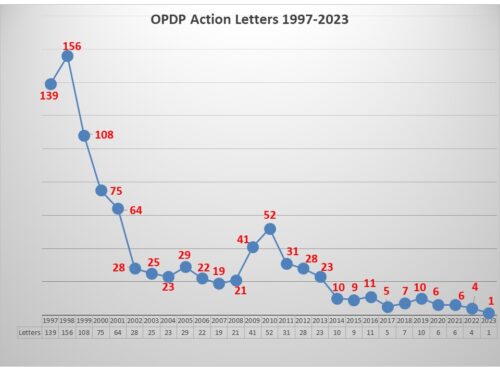
First let’s look at the enforcement pattern compared to previous years.  The chart below plots out the number of letters issued each year since 1997.  While enforcement began to creep back up slowly in 2009 and 2010, it appears to have fallen off again.

Moving on to the letters of the fourth quarter themselves… During the first three quarters of the year, OPDP had issued only 21 letters. During the final quarter of 2011, they sent 9 more that covered 24 different cited violations;

  • Minimization/omission of risk information – 9
  • Unsubstantiated Superiority Claim – 4
  • Overstatement of Efficacy -4
  • Unsubstantiated Claims – 2
  • Omission of Material Facts – 1
  • Misleading Claim – 1
  • Inadequate Presentation of Established Name – 1
  • Inadequate Statement of Indication -1
  • Promotion of Unapproved Use -1

The communications vehicles involved included 2 Websites, a rebate card, an exhibit panel, and exhibit booth, 2 sell sheets and oral statements.

While each violation cannot be reviewed, here are a few of the more interesting:

  • The statement that a treatment provided “most relief” was deemed to be a unsubstantiated supriority claim;
  • The phrase “simple, hassle-free use” became an unsubstantiated claim when the PI described a thirteen-step procedure;
  • A booth display that had the indication information on top and the risk information on bottom where it was obscured by bags, boxes and materials was deemed a de facto  omission of risk information.

There were many more, but the risk information issues have always been the most prevalent violation cited in regulatory action letters. As to the number, even with the surge of the last quarter, there is still a decline from the previous year.  There had been some thought that when policy was changed in 2009 that no longer required review by legal counsel of most action letters, that there would be an increase in the level of enforcement, but that does not appear to be the case.

Meanwhile, in 2012, FDA’s OPDP has issued its first letter of the year.

Posted in Warning Letters | Comments Off