Warning and NOV Summary – 1st Quarter 2013

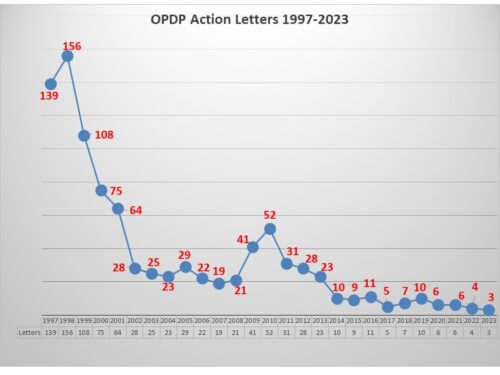
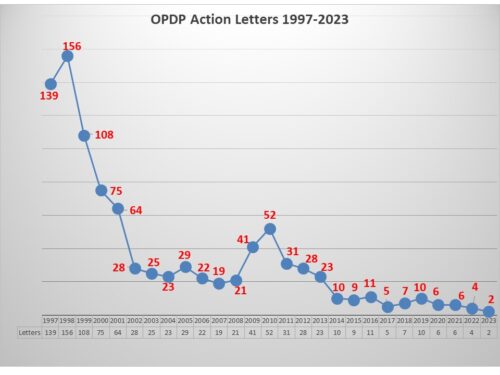
Each quarter I regularly try to provide a little insight into OPDP’s current thinking as expressed through the issuance of Warning and NOV letters.  What we saw last year is that the number of such letters after rising a bit in 2009 and 2010 in number, slumped again in 2012.

But that is nothing compared to the first quarter of 2013, where we saw a total of 3, count ‘em 3, letters issued from OPDP to industry.  Despite the fact that this quarter provides slim pickings, we persevere.

From this quarter, the three letters involved only three communications vehicles, none of which were digital properties (two were brochures) and none of which were Warning Letters and none of which involved drugs with boxed warnings.

The category for most common violation is usually Risk Minimization and while that did get the most this quarter, it tied with Superiority Claims at 3 and 3.  Also included in this quarter was one instance of Overstatement of Efficacy, one Unsubstantiated Claim and one Inadequate Communication of Indication, making a total of 9 violations for the quarter, or 3 per letter.

Will keep you posted on next quarter some time in July.

Share this:
Share this page via Email Share this page via Stumble Upon Share this page via Digg this Share this page via Facebook Share this page via Twitter
Posted in Warning Letters | Comments Off

Weekly Roundup – 4-19-13

It has been a really busy week with travel and work that last Friday I didn’t even get to the Weekly Roundup.  The schedule has been so busy, leaving no spare time for either posting here on the blog or continuing to clear away the dead growth in the garden.  We have had a few minutes of Spring that already seem tempted to ebb into humid muggy days that we should not get till Summer.

But here is a bit of what I saw that happened when I came up for air:

That’s it for me this week.  I hope everyone has a good and safe weekend.

Share this:
Share this page via Email Share this page via Stumble Upon Share this page via Digg this Share this page via Facebook Share this page via Twitter
Posted in Weekly Roundup | Comments Off

Comparing Types of Violations Between Digital and Non-Digital

In the wake of publishing “FDA Communications Oversight in a Digital Era” in last week’s blog post, I have been asked some interesting questions.  One of them sought to know whether there was a difference between the types of violations of non-digital (traditional) communications vehicles versus digital.

Again, the paper was based on a data base I compiled that tracks OPDP letters to pharma companies from the years 2004-2013, inclusive, covering nearly 1000 violations cited by FDA.  For this study, I specifically examined the years 2008-2012 in order to capture the uptake of social media by both mainstream media as well as patients and industry.  For the period, there were 173 letters covering 675 violations.  Each violation was characterized as belonging to a non-digital communications vehicle (brochure, advertisement, spoken word, e.g.) or a digital property (website, banner ad, e.g.).  There were 385 non-digital violations and 290 digital violations.

Here is a look at non-digital vehicles.  You can see that 1 in 3 violations involve either the minimization of risk or the failure to include risk information.  The second highest share of the violations goes to the overstatement of efficacy.

The breakdown shows a very different profile for the digital violations, where the failure to include risk information or minimization of risk had a much larger profile (56%) for digital properties rather than non-digital communications vehicles.  Why?

Remember 2009 when OPDP (then DDMAC) issued 14 letters regarding 45 brands for online ads?  That added a huge number of risk-related violations since the reason those ads were being cited is that the “one-click rule” that everyone thought existed, in fact, did not. That artificially inflated the number of violations related to risk.

When you remove those violations, the two are more similar, though there remains a slightly higher level of risk violations as well as a higher rate of overstatement of efficacy and promotion of an unapproved product. With respect to the unapproved products, these involved 3 oncology products; one involved a Webcast and the rest were Website content.

In the end, the old – it is the message, not the medium, seems to hold true – at least when comparing the types of violations between digital and non-digital properties.

Share this:
Share this page via Email Share this page via Stumble Upon Share this page via Digg this Share this page via Facebook Share this page via Twitter
Posted in Social Media, Warning Letters | 1 Comment

Weekly Roundup – 4-5-13

The daffodils are up and being rounded up in bunches and slipped into vases around the house, spreading good cheer, but overall Spring is still seemingly quite shy though indications are that is about to change.  It is perhaps a good time to give the grill on the BBQ pit a good scraping for the coming season.  It has been a mostly quiet week at FDA – perhaps everyone went away for a Spring Break! As of publication time, there were no press releases from the agency this week, now OPDP warning letters posted…. all quiet.

In the meantime, there were some interesting things:

  • Judge Rules Plan B Should Go OTC for All Ages – In a new chapter of a very long story of “morning after” contraception, a federal judge has reversed a reversal of a decision regarding the availability of an over-the-counter application for Plan B.  In 2011, FDA was poised to approve the OTC application but that decision was historically ordered reversed by the intervention of HHS.  Today that reversal was reversed by a federal judge and ordered FDA to approve the OTC application.  Will this close the book on the subject?
  • H.R.1150 – Preservation of Antibiotics for Medical Treatment Act - The legislative developments are pretty much appearing here whenever I catch them.  This bill was introduced in the House by Congresswoman Louise Slaughter (D-NY-25) with the purpose of addressing emerging antibiotic resistance as a result of use of medically important antibiotics to a food-producing animal for non-routine disease control.
  • FDA Commissioner Hamburg Speaks Out on Painkillers – In a blog posting on the FDA blog FDAVoice entitled “When Pain Relievers Cause Pain, Society Must Act“, Commissioner Margaret Hamburg addressed the abuse of opioids in the U.S.  Stating that in “2010, an estimated 16,651 peopled (sic) died because of inappropriate use of prescription opioid drugs, a 313 percent increase over the past decade”, she outlined FDA’s approach which involved a blend of continuing research about pain, discovery of abuse-deterrent formulations, more accurate labeling, increased education, mandatory training programs for prescribers, new packaging and improving availability of new products that can treat abuse and overdose.  On that same day, Senate Minority Leader Mitch McConnell sent a letter to FDA urging the agency to consider ways to ensure that tamper-resistant efforts taken by brand name pain killers are also in use by generics that come to market.

That’s it for me this week folks.  I hope you all have wonderful weekends and see you next week, when surely Spring will have grown more emboldened.

Share this:
Share this page via Email Share this page via Stumble Upon Share this page via Digg this Share this page via Facebook Share this page via Twitter
Posted in Warning Letters | Comments Off

Some Digital and Social Media Guidance – FDA Regulation of Pharma Communications in a Digital Era – A White Paper

I have been working to assemble  a data base of  FDA/OPDP Warning and NOV letters spanning the years 2004-present, tracking activity through a number of fields.  The database now includes hundreds of letters and covers nearly 1000 violations cited by the agency with regard to communications by pharma about medical products.

I tracked several different fields of information.  I can sort by company, time period, product, product indication, type of violation, type of communications vehicle, whether or not the product had a boxed warning, and for our purposes today, whether or not it was a digital communications vehicle (web site, social media e.g.) or a traditional medium (print ad, brochure).

For some time, OPDP – and prior to that DDMAC – has been struggling to understand and respond to the regulatory challenges posed by new emerging digital communications platforms, with little to show for it. Accordingly there are a number of outstanding questions about how OPDP regulates communications on the Internet and digital platforms, including social media.  For some in industry, the lack of guidance has had a chilling effect on participation in social media and even the Internet, despite the fact that it is a resource to which patients regularly turn for information.

As a result, digital and social media have become a sort of regulatory bogeyman.  Lacking any sort of formal guidance from the agency, the only peek into FDA’s point of view is to examine enforcement patterns.  So I have used the data base to compare enforcement patterns vis a vis digital communications. For purposes of this paper, I narrowed the search to the years 2008-2012 (inclusive) to coincide with the ascendency of social and digital media use by pharma.  For this period, I wanted to see how violations by digital communications properties compared to violations by traditional (non-digital) communications vehicles.

In short, I asked the data the following five questions:

  1. What was the frequency enforcement among digital versus nondigital communications vehicles used by pharmaceutical companies?
  2. What was the comparison of the number of violations involving nondigital communications versus digital communications?
  3. Was there a greater frequency of more serious violations for digital versus nondigital communications vehicles?
  4. In looking at a year-by-year breakdown, is the rate of violations related to digital communications increasing with the heightened use of digital and social media?
  5. What has been the frequency of involvement of social media assets to generate regulatory action letters from OPDP?

You can download the paper here or by clicking on the photo of the cover above.

I hope that the answers to these questions provide a useful basis to help communicators in consideration of their own efforts to talk about medicines in today’s communications and regulatory environment.

The paper has its limitations.  For example, the most obvious limitation – since we do not know what proportion of communications by industry is divided between digital and non-digital efforts, the data cannot say whether or not digital is over or under represented. In other words, if 50% of the communications effort is in digital, and it gets 50% of the regulatory action violations cited by FDA/OPDP, then it is proportional – however we have no way of knowing that context.

In the coming weeks, you will find additional analyses from the OPDP action letter data base here on Eye on FDA.

Share this:
Share this page via Email Share this page via Stumble Upon Share this page via Digg this Share this page via Facebook Share this page via Twitter
Posted in New and Social Media, Warning Letters | 4 Comments