May 24, 2013

Yee Hah! Memorial Day weekend is upon us – and not a moment too soon. It is time for hectic Spring to ease into lazier days of Summer. I hope. As for me, it may seem that I have been lazy of late, but it has been quite the opposite. It looks like it has been a busy week all around and here is a bit of what happened that I thought was interesting:
- Dr. Woodcock Testifies on Drug Compounding – On May 23, Dr. Janet Woodcock, Director of the Center for Drug Evaluation and Research (CDER) provided testimony before the House Committee on Energy and Commerce Subcommittee on Health regarding Drug Compounding. Citing the recent issue that arose related to a fungal meningitis outbreak with a compounded product that has resulted in multiple deaths and illnesses, she provided a historical overview stretching back to 1997 of several other incidents involving compounded products and also discussed additional incidents coming to light this year. She outlined steps FDA is taking in instituting a risk-based model to identify pharmacies for priority inspections and using investigators who would normally be involved in the inspection of conventional drug manufacturers. She provided interesting details of this experience and noted that the agency is hampered by ambiguities regarding the agency’s enforcement authority in this space. The testimony has been added to the FDA and Compounding resource tab that has been added to the Eye on FDA blog site.
- FDA Approves Marketing of New Diabetes Diagnostic Test – Last week there were a number of “firsts” in the Weekly Roundup and this week we continue in that vein with the announcement by FDA that it was allowing the marketing of the fist A1c test labeled for diagnosing diabetes. The COBAS INEGRA 800 Tina-quant HbA1cDx assay manufactured by Roche will be available for use by health care professionals.
- FDA Activities Related to China - Ever been curious about what FDA does to support the safety of the global supply chain? This week FDA provided testimony before the Congressional-Executive Commission on China on FDA’s activities related to that country. Though country-specific, it is also quite educational about the challenges the agency faces and the enormous undertaking the task is in a time of increased globalization.
That’s it for me this week folks. My thanks to those of you who joined me for the Webinar I held earlier this week. I hope you all have a wonderful and relaxing long weekend.
May 17, 2013

It has been a busy May. From working in the yard to transform it from looking like property on which Boo Radley might have a house to putting on panel discussions and layers of business travel to grading papers and posting final grades to end up this semester of teaching. I didn’t even get time for the Weekly Roundup last week – when lots happened – so I was determined to get it out this week and here it is. This week there were a spate of interesting approvals – so let’s round it up! Yee Hah!
But before I do, let me remind you that I will be doing a Webinar on Tuesday, May 21 at 12 Noon Eastern Time where I will be reviewing my data base on FDA Warning and Untitled Letters and comparing enforcement respecting digital versus non-digital communications vehicles. The Webinar is free and open and I will be going into more detail and discussing additional aspects beyond what was in my White Paper on the same topic from last month – so sign up here.
The Stamp of Approval was busy this week at FDA:
- First Companion Diagnostic to Detect Gene Mutation Associated with a Certain Type of Lung Cancer Approved - FDA announced early this week the approval of the cobas EGFR Mutation test which is a companion diagnostic test to be used in conjunction with an already approved drug. The test detects epidermal growth factor receptor (EGFR) which exist in approximately 10% of non-small cell lung cancers, the most common type of lung cancer. This type of diagnostic will provide valuable direction in determining which patients will benefit from which treatment.
- First Nimodipine Oral Solution Approved for Some Brain Hemorrhage Patients – Though approved on May 10, FDA issued a press release on May 14 about the approval of Nymalize oral solution to treat patients who have experienced a ruptured blood vessel in the brain. Previously this medication had only been available as a liquid filled gel capsule.
- Prostate Cancer Drug Approved – A new drug for those fighting advanced prostate cancer was approved by FDA this week called Xofigo (radium Ra 223 dichloride) three months ahead of the PDUFA date under a priority review. Xofigo is intended for use in men whose cancer has spread after receiving medical or surgical therapy to lower testosterone. It is the second prostate cancer treatment approved this year.
- Simponi is Approved for Ulcertative Colitis - FDA approved Simponi (golimumab) injection to treat moderate to severe ulcerative colitis in adults with moderate to severe US that is resistant to prior treatment or which requires continuous steroid therapy. Simponi works by blocking tumor necrosis factor (TNF). Simponi is approved for the treatment of rheumatoid arthritis, psoriatic arthritis and ankylosing spondylitis.
That’s it for me this week. Have a good weekend everyone. Come to the Webinar on Tuesday!
May 13, 2013
Many may recall that in early April, I released a paper I did here on Eye on FDA called “FDA Communications Oversight in a Digital Era” that examined the patterns of enforcement by FDA’s Office of Prescription Drug Promotion as expressed through warning and untitled letters during the years 2008-2012 assessing what differences may exist between traditional communications vehicles and digital properties.
The paper is based on a data base that I have compiled that characterizes warning and untitled letters from 2004 onward. The years 2008-2012 were chosen to reflect a period of time when there was an increasing use of the Internet by people seeking healthcare information and by the ascendancy of social media platforms.
YOU’VE READ THE BOOK! NOW SEE THE MOVIE!
Well, not quite a movie. On Tuesday, May 21 at 12 P.M. Easter Time, I will be conducting a Webinar that overviews the findings from the White Paper and will provide some expanded comparisons of digital and social media, as well as a few other observations from the data base. The Webinar is free and if you would like to register, you can do so here.
The data base allows a vast number of analyses having tracked multiple fields of characteristics including whether a communications vehicle was digital, what type of label the product had (boxed warning or not), the type of violations, the treatment area for the product involved and many more.
I hope you will join me on May 21.
May 3, 2013

The grass is not greener on my side, mainly because it is mostly not there. The lawn, if you want to call it that, looks like it needs a lot of attention – probably more than I have to give it. Still, that did not stop me from mowing what was there this week for the first time this season as the old mower really did (miraculously) start up for another year. I am happy to say that many weeds met their end, pulled out by the root after a good, soaking rain….
It was a busy week on many friends, particularly for those of us with our eye on FDA. Here are a few of the things that I wanted to bring to your attention in case it got by you:
- FDA Approves Plan B for Wider Age Range OTC – This was certainly one of the more interesting developments that transpired this week and a lot happened here. First, prior to this week, a court ordered that age restrictions for access to OTC Plan B contraceptive be removed. Then – this week, FDA announced it was approving Plan B for use by women without a prescription if they were age 15 years or older. Then, it was reported that the Justice Department announced that it would be appealing that court decision. This has been a long, long saga. Obviously, it will get longer.
- EMA Opens up Public Comment Period for Guideline on Biosimilars – This week EMA posted their Guideline on Similar Biological Medical Products on line to invite public comment. The comment period opened May 2 and will run until October 31.
- FDA Approves Procysbi for Rare Genetic Condition – Procysbi (cysteamine bitartrate), marketed by Raptor Pharmaceuticals, was approved this week by FDA for the treatment of nephropathic cystinosis in children and adults. This is a rare genetic condition that only affects an estimated 500 patients in the U.S. and 3000 worldwide which causes a protein building block (cystine) to build up in every cell of the body which in turn, causes kidney problems and lead to small growth and stature, among other things.
- FDA Investigating Added Caffeine – The agency announced this week that in the face of a growing trend where caffeine is being added to a wider span of food and beverage products there will be a higher level of scrutiny on the part of FDA. Caffeine was approved nearly 60 years ago for use in the manufacturing of cola beverages, but the agency says that existing rules never anticipated the current proliferation of products. The Q&A supplied by FDA however did not provide much detail into the process the agency will be using to conduct its investigation into existing caffeine in products and what to do about it.
Speaking of caffeine, I think I’m going to take a break here. I hope you all have a wonderful weekend and are enjoying Spring.
May 1, 2013
It may seem that I write a lot about the letters that FDA puts out regarding industry promotion and communication, but that is exactly what the nature of this blog is about. Other things can be interesting, particularly policy developments, but for those who work with medical products and communication, this is the heart of the matter and we have to look for patterns to gain insights.
Since putting together the database of NOV and Warning letters issued by FDA’s Office of Prescription Drug Promotion (OPDP), I have been looking to assess a number of patterns. Sometimes the meaning is obvious, in other’s I am left to speculate. This is one of the latter.
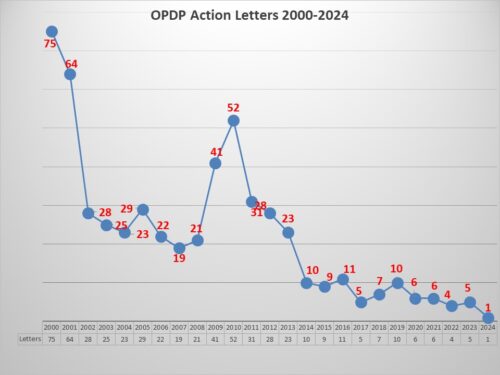
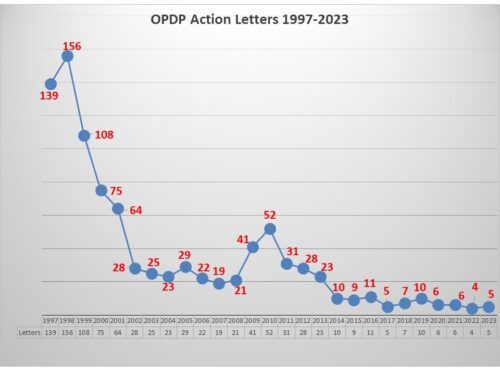
Every regular reader of Eye on FDA will note that they have frequently seen this chart evolve. Here is a profile of the combined pattern of Warning Letters and Notice of Violation letters issued by OPDP since 1997 and one will readily observe that the number of such letters experienced a steep decline after the 1990s. So that is the first point – there are fewer letters than there used to be.
Looking at the same data up close for recent past, here is a more detailed version looking at the period 2004-2012, which is the span of time covered by the Eye on FDA Warning/NOV letter database.
When you break it down between the two types of letters – the more serious Warning Letter (expressed in RED) versus the NOV letters (expressed in BLUE), you also see that the proportion of Warning Letters has gone down. So far, for 2013, there are only 4 letters.
So, bottom line, the trend for the number of letters issued has gone down and the trend for the more serious type of letter has also gone down. Cause? I’m not sure. But would welcome ideas and thoughts from anyone willing to comment.